Sunday, December 8, 2019

Negombo (Sinhala: මීගමුව) Lagoon


Negombo is a major city (about 140,000 people) near Colombo, the capital of Sri Lanka.  The Bandaranaike international airport, where we landed, is here.  So we've spent the first week of our trip here.

Negombo has 3 distinct sections: the tourist area with its long sandy beach, touristy shops and restaurants, the busy city/commercial part, and the Negombo Lagoon.  A large salt water body that's separated from the ocean by a long narrow piece of land, that has very poor sections and some pretty swanky areas.

We stayed in the tourist area for 3 nights.  It was a great place to start our trip.  It was easy and had lots to offer.

But since then, we've been staying in the lagoon area.  In a house that's owned by Tom, a British man who's offered us his hospitality because he lives in a big house by himself, and wants our company. Toby met the man via an online Sri Lanka expat chat group. I was a little uncomfortable accepting Tom's hospitality at first.  Why would someone invite virtual strangers into their home?  For free!?  But here we are. Clearly welcome.  For our charming selves :)

While staying here, we've walked the neighbourhood, visited little churches, gone shopping, and explored the peninsula.  It's been a nice quiet time.
Pictures
1- A fishing canoe in the entrance to Negombo Lagoon.
2- We wanted to buy and eat a pineaple, but had no knife to cut it.  The very nice clerk in the store was reluctant to cut if for us.  But a  man delivering cases of water to the store, offered to cut it.  Super kind!
3 - The secondary/residential streets in the Negombo Lagoon area are very narrow!
4- We bought a pineapple from a street vendor.  So good!!!
5- These are two very simple fishing boats.  Their paddles are bamboo stalks cut in half.


Friday, December 6, 2019

Buffalo Curd and Hoppers!

Sri Lanka offers many delicious foods. The first one I tried was buffalo curd!!

Buffalo curd is a firm creamy tart plain yogurt made from...yep! buffalo milk!  It's made by fermenting and boiling the milk for 2 hours to reduce the water content. Then cooling the product to room temperature, sealing it with paper and putting it aside for 12 hours to set.

It's sometimes sold in stores in plastic pots, like margarine tubs.  But the tradition is to put it into baked clay pots called hatti. This gives the curd a distinctive taste and texture, that the plastic  cannot. People then use the pots for cooking.  


My first exposure to buffalo curd was at the Sunday market in Negombo.  We bought it in a small, single serving size clay pot. Adorable!  The spoon provided was a folded palm frond.  Really??? Yes!!!!

I wasn't so sure about the curd that first day.  I was jet lagged and the curd was warm and a little runny.  But I am now a huge fan!!  It's delicious, creamy and refreshing cold. Best eaten with bits of banana and nuts.  It's traditionally eaten with trickle - a coconut syrup.

Pictures
1- My little clay pot of buffalo curd.
2-3 There are a few brands of buffalo curd.  Milk in Sinhala is "kiri" the pot is a "hatti".  So in the stores, you can ask for kiri hatti.
4- A hopper with sambal on a banana (?) leaf.  A hopper is a thin rice batter cooked in a round pot so the result looks like a pretty bowl. Hoppers sometimes come with a cooked egg in the bottom.  This one just had a lump of cooked rice batter. Sambal is shredded coconut with lime and spices.
5 - Pittu with sambal.  Pittu is chopped up rice served with coconut milk.  Delicious!  The leaf was stuffed with lavari a mildly sweet paste.  We're not sure what it's made with.
6- A man in a tiny street kiosk making hoppers.


Wednesday, December 4, 2019

Sri Lanka Means...


Does the name “Sri Lanka” mean anything in particular?  Yes.  But it’s a little complicated.

"Sri" is an honoring prefix in Sinhala, one of the main languages in Sri Lanka. It can mean "His/her excellency" or "honorable".  But sri also means “resplendent” in Sanskrit, a classic language of Buddhism, one of the religions in Sri Lanka.

In many south and southeast Asian languages, the word "lanka" means island.  Since Sri Lanka is the biggest island in South Asia, lanka likely came to mean this particular island. Lanka may also come from the Tamil word "ilanku - இலங்கு" which means "that which glitters".  Tamils are one of the cultural groups that live in Sri Lanka.

So Sri Lanka can mean a few things.  Like "Honourable glitter".  Fun. But not the usual interpretation. The most common is "Resplendent island". Pretty isn't it?

Sri Lanka only received this name in 1972, when it became an independant republic. From 1815 to 1972, under British rule, Sri Lanka was called Ceylon.  Which might have come from "Sielen Diva ", the Greek word for the island.  And from the derivatives for Sielen, such as the Ceilán (Spanish), Selon (French), and Ceylon (English)! 
 
Sound familiar?  You might have heard of Ceylon tea.  That's actually Sri Lankan tea!

Pictures:
1- Me, modeling a sarong.  6 meters of fabric skillfully folded, wrapped, tucked, and pinned. The little black top is called a blouse.
2- Toby and his cousin standing in front of a map of Sri Lanka.  Turns out his cousin works at Reggie's guesthouse, the first place we stayed.  Total small world coincidence!!
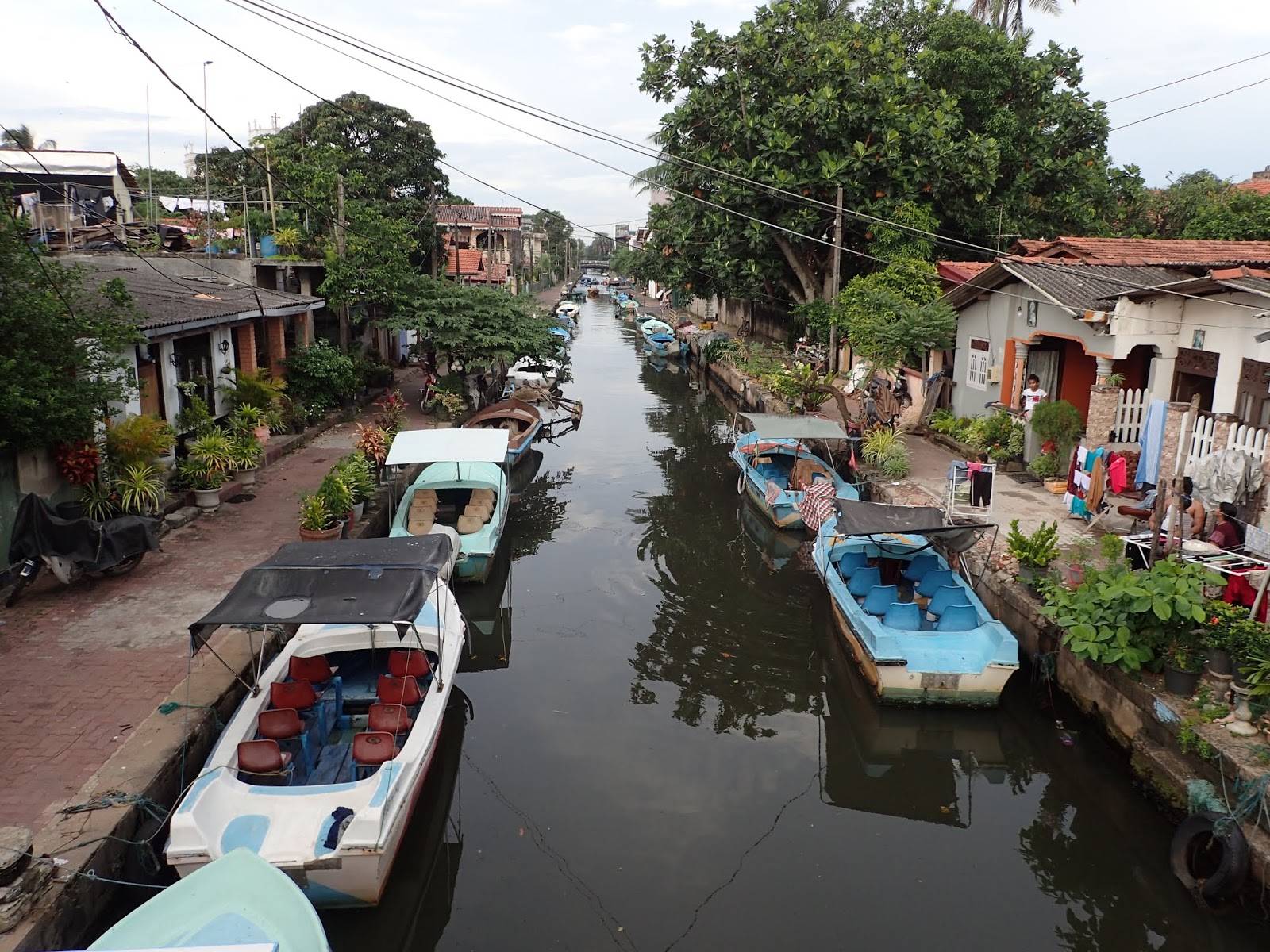
3 and 4 - When the Dutch ruled the island (1640 -1796), they built a bunch of canals for transportation.  Many are still in use.  
5- Negombo, where we are currently staying, is predominantly catholic.  There are shrines like this in many locations throughout the city. 


Sunday, December 1, 2019

Day 1!! Negombo Sunday Food and Fish Markets


After 24 hours of travel and only kinda sleeping on the plane, we were tired and needed a shower.  But when we arrived at our beach guesthouse in Negombo , it was only 8 am and our room wasn’t ready. So we stored our bags and got walking!  

The highlight for our walk was a large outdoor fish and produce market.  So much fun!  There was such a variety of foods for sale!  It was raining on and off, so there were tarps and rope everywhere.  Many low enough that you had to duck your head to pass under.  
 
It was fun to watch Toby negotiate prices with the vendors in Sinhalese, one of the languages commonly spoken here.  Sinhalese was his first language.  He’s forgotten a lot of it.  But it impressed me!!


Pictures
1-Negombo beach. I put my feet in the Indian Ocean for the 1st ever today!
2 -An outrigger fishing boat (oruwa in Sinhalese) on the beach.  There are many types of fishing boats in use.
3-  A vendor at the Sunday market.  Their produce is on tarps on the ground
4- Bulk spices, lentils, etc for sale at the Sunday market.  I loved that we were right by the ocean. 
5- Toby enjoying his first King coconut!
6- This very interesting man told me about the fish drying process, which includes lots of salt, tarps, and sunshine.